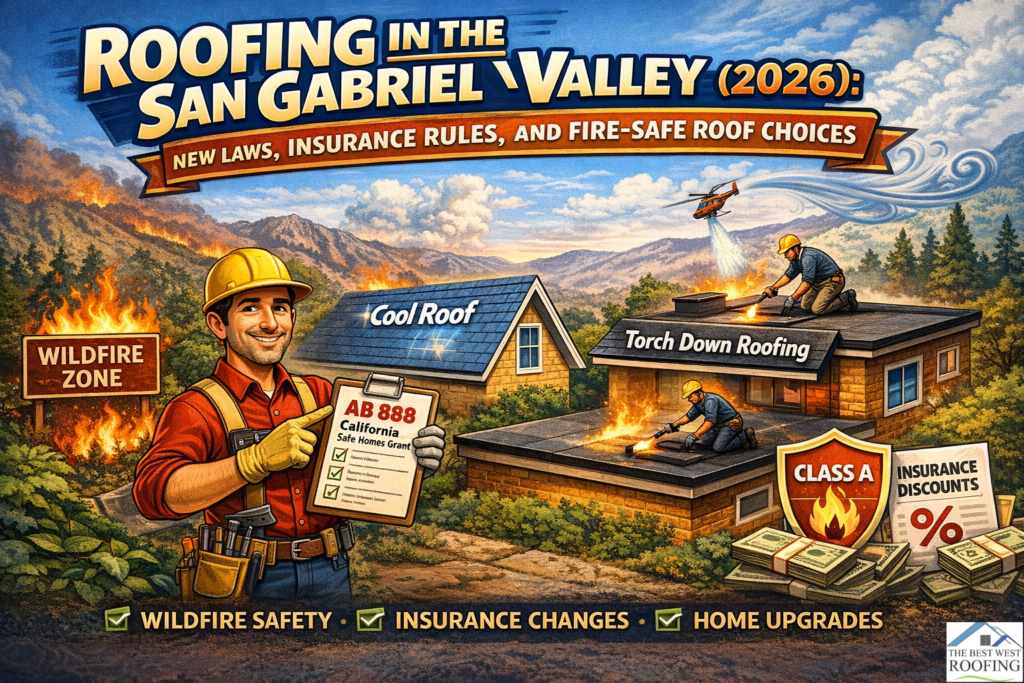
Homeowners in the San Gabriel Valley face increasing wildfire risk, strong sun exposure, and changing insurance requirements. In 2026, new California legislation and regulatory reforms are reshaping how residents should think about roofing, maintenance, and fire protection.
This guide explains what SGV homeowners need to know now — with verified sources you can cite.
California Safe Homes Grant (AB 888): What It Means for Homeowners
The most significant statewide change affecting roofing decisions is California’s Safe Homes Act (AB 888), which establishes a grant program to help homeowners fund wildfire mitigation improvements.
The law authorizes financial assistance for projects that reduce home ignition risk, including:
- Fire-resistant roofing
- Ember-resistant vents
- Defensible-space upgrades
You can read the full bill text here:
👉 https://legiscan.com/CA/text/AB888/id/3272869
The program is administered through the California Department of Insurance and is designed to prioritize vulnerable households in wildfire-prone regions.
Insurance Changes: Safer From Wildfires Framework
California regulators have introduced mitigation-based insurance rules intended to reward homeowners who reduce wildfire risk.
The Department of Insurance explains these reforms here:
👉 https://www.insurance.ca.gov/0400-news/0102-alerts/2025/Commissioner-Lara-Announces-New-Wildfire.cfm
These policies encourage insurers to consider protective steps such as:
- Class A fire-rated roofing
- Ember-resistant construction features
- Vegetation management near structures
Fire-Rated Roofing and California Building Standards
California building codes already require Class A roofing in many wildfire hazard zones, especially for new construction or major remodels.
The California Building Standards Commission provides guidance here:
👉 https://www.dgs.ca.gov/BSC/Codes
You can also review wildfire hazard severity zone maps to see whether a property falls in a regulated area:
👉 https://osfm.fire.ca.gov/what-we-do/community-wildfire-preparedness-and-mitigation/fire-hazard-severity-zones
Cool Roof Performance in Hot Climates
Reflective roofing materials can reduce heat absorption and improve energy efficiency in warm regions like Southern California.
Research cited by the commission shows reflective roofs can lower surface temperatures and reduce cooling demand in hot climates.
Flat Roof Systems: What Homeowners Should Evaluate
While materials vary, California construction guidance emphasizes evaluating roofing systems based on:
- Fire rating compliance
- UV resistance
- Proper installation
- Long-term maintenance
Homeowners should consult licensed roofing contractors familiar with local codes and climate conditions when choosing systems.
California’s Contractors State License Board offers consumer roofing guidance here:
👉 https://www.cslb.ca.gov/Consumers/Hire_A_Contractor/
Frequently Asked Questions
Q: Can I get a government grant for a new roof in California? A: Yes. The California Safe Homes Act (AB 888) provides grants to eligible homeowners in high-fire-risk areas to replace flammable roofs with Class A Fire-Rated systems. Homeowners should check their eligibility through the California Department of Insurance (insurance.ca.gov) portal starting in March 2026.
Q: Is Torch Down or TPO better for the San Gabriel Valley heat? A: Torch Down (Modified Bitumen) is the preferred choice for the SGV climate. Its asphalt-and-rubber composition is specifically designed for high-heat environments where thermal expansion is a factor. TPO (Thermoplastic Polyolefin) is a single-ply membrane that can experience accelerated UV degradation and seam failure in the intense sun of the San Gabriel basin.
Q: What is “Zone Zero” in California roofing? A: Zone Zero refers to the 5-foot non-combustible perimeter surrounding a home. Under 2026 home-hardening standards, this area must be cleared of vegetation and flammable materials. Replacing a flammable roof with a Class A system and establishing Zone Zero are the two most effective ways to lower wildfire risk and secure insurance discounts.
Q: How do I know if my flat roof leak can be repaired or needs replacement? A: If the leak is isolated to a specific seam or a single puncture, a professional heat-welded repair can extend the life of a Torch Down roof by 5+ years. However, if the roof is “alligatoring” (cracking across the surface) or the underlying insulation is saturated, a full re-roof is usually necessary to prevent structural rot.