Los Angeles presents a unique set of challenges for asphalt shingle roofs. While we don’t deal with heavy snow, our roofs endure intense UV radiation, thermal expansion from 100°F+ heatwaves, and increasingly volatile seasonal rainstorms. When these factors converge, a minor leak can quickly escalate into a structural emergency.
1. Defining a Roofing Emergency in Los Angeles
Not every broken shingle is an emergency, but in the context of Los Angeles real estate and insurance, three specific scenarios require immediate action:
-
Active Interior Leaks: If water is reaching your drywall or insulation, the structural integrity of your ceiling is at risk. In LA’s dense housing market, mold can begin to grow within 24 to 48 hours of moisture intrusion.
-
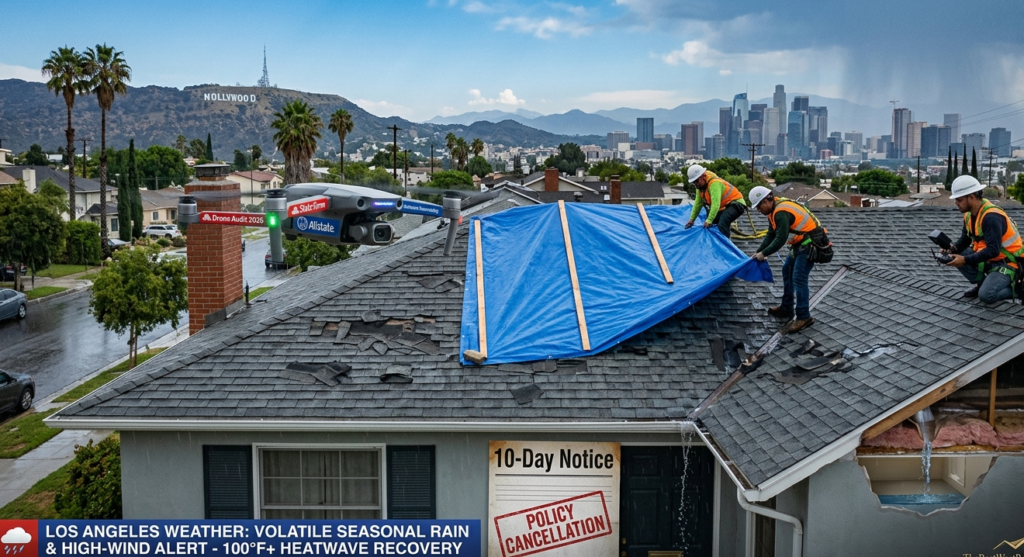
The “Insurance Drone” Red Flag: As of 2026, many LA insurers (including major carriers like State Farm and Allstate) are using autonomous drone audits to inspect roofs before policy renewals. If a drone flags missing shingles or “alligatoring” (cracked asphalt), you may receive a 10-day notice to perform an emergency asphalt shingle repair or face total policy cancellation.
-
Storm-Driven Wind Uplift: Santa Ana winds can hit 60+ MPH, stripping shingles from the roof’s edge and exposing the underlayment. Without the protection of the shingles, your roof is essentially a sponge waiting for the next rain.
2. The Step-by-Step Emergency Repair Process
If you find yourself in a crisis, the goal is stabilization first, followed by a permanent, code-compliant fix.
Phase 1: Temporary Stabilization (The Tarping)
If rain is in the forecast and your roof is compromised, a professional crew will perform “emergency tarping.”
-
Why it matters: Tarping prevents further interior damage and satisfies your “duty to mitigate” for insurance claims.
-
The LA Standard: Ensure your contractor uses a high-visibility, heavy-duty UV-resistant tarp secured with wooden “furring strips.” Avoid using sandbags alone, as the intense Santa Ana winds can easily blow them off.
Phase 2: Damage Assessment and Drone-Proofing
Once the weather clears, a detailed inspection is required. In 2026, top-tier LA contractors use their own drones to “pre-scan” your roof. This allows them to see exactly what the insurance drones see—missing granules, rusted flashing, and curled edges.
Phase 3: The Repair vs. Replacement Decision
In Los Angeles, the Los Angeles Department of Building and Safety (LADBS) allows for repairs on up to 25% of the total roof area without requiring a full asphalt shingle roof replacement.
-
When to Repair: If the damage is isolated to a specific valley or a single wind-damaged slope.
-
When to Replace: If the asphalt shingles are “brittle” (losing their petrochemical oils) or if the “alligatoring” is widespread across all slopes.
3. Essential Materials for Los Angeles Resilience
When performing an emergency asphalt shingle repair, the materials you choose must meet the 2026 California Green Building Standards (Title 24).
-
Cool Roof Shingles: In LA, any significant repair or replacement must utilize “Cool Roof” shingles. These contain specialized granules that reflect UV rays, keeping your attic up to 30°F cooler and lowering your AC bills.
-
Class A Fire Rating: This is non-negotiable for Los Angeles. All asphalt shingles used in repairs must have an ASTM E108 Class A rating to protect against ember intrusion during wildfire season.
-
High-Wind Sealants: For repairs in wind-prone areas like the San Fernando Valley or the Santa Monica Mountains, use shingles with reinforced “nailing zones” and high-performance adhesive strips.
4. Navigating Insurance Claims in 2026
The insurance landscape in California has become highly technical. To ensure your emergency asphalt shingle repair is covered, you must provide:
-
Time-Stamped Photo Evidence: High-resolution photos of the damage before the tarp is applied.
-
A “Certificate of Hardening”: Proof that the repair was done using fire-rated materials.
-
LADBS Permit Documentation: For significant repairs, a permit is proof that the work meets the current safety code.
TheBestWestRoofing Service: Your Los Angeles Emergency Experts
When disaster strikes, you need a partner who understands the urgency of Los Angeles living. TheBestWestRoofing Service specializes in emergency asphalt shingle repair designed to satisfy both your home’s structural needs and your insurance company’s strict 2026 requirements.
TheBestWestRoofing Service provides the localized expertise needed to protect your Los Angeles investment.
FAQ: Emergency Roofing in Los Angeles
Q: How much does emergency asphalt shingle repair cost in Los Angeles in 2026? A: Costs in LA vary based on the height of the roof and the extent of the damage. Minor repairs (replacing a few bundles of shingles) typically range from $450 to $1,200. Emergency tarping services usually start around $300 to $600. For a full asphalt shingle roof replacement on a 2,000 sq. ft. home, prices generally fall between $10,000 and $20,000, depending on the quality of the “Cool Roof” materials chosen.
Q: Will my insurance pay for an emergency roof repair after a Los Angeles storm? A: Most standard “HO-3” policies in California cover “sudden and accidental” damage, such as a tree limb falling or shingles being blown off by wind. However, they rarely cover leaks caused by “lack of maintenance” or “old age.” Having TheBestWestRoofing Service perform a professional inspection is the best way to determine if your damage is claimable.
Q: What are the Los Angeles “Cool Roof” requirements for 2026? A: According to the LADBS, any new asphalt shingle roof installation or significant repair must use materials with a high Solar Reflectance Index (SRI). For residential homes, this usually means a minimum SRI of 16 to 20, depending on the specific neighborhood and roof slope.
Q: How long does a shingle roof repair take in LA? A: Most emergency asphalt shingle repairs can be completed in a single day. If a full asphalt shingle roof replacement is required, the project typically takes 2 to 4 days, including the tear-off and city inspections.