
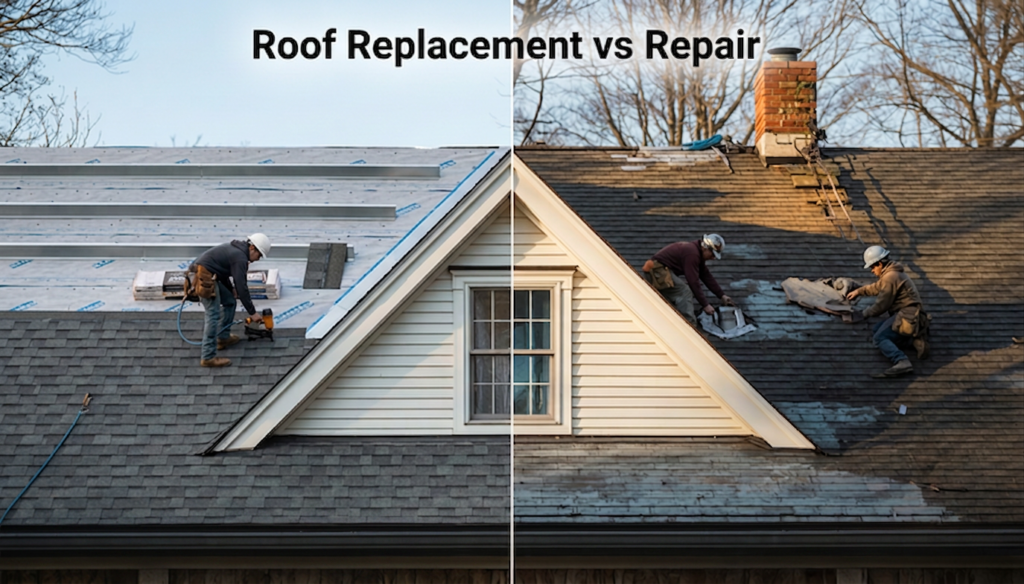
Standing in your driveway looking up at a stained ceiling or a handful of cracked tiles, the question is always the same: do I need a repair, or do I need a whole new roof?
It’s not a guess, and it shouldn’t feel like one. Licensed roofers evaluate the same handful of factors on every inspection — roof age, how much of the roof is affected, the material’s condition, and what’s happening underneath the surface. Once you know what those factors are, the “repair or replace” question stops being confusing and starts being obvious.
This guide walks through exactly how contractors make that call, what’s different about making that call in Los Angeles specifically (Title 24 rules, tile roofs, marine layer moisture, and wildfire-hardening codes all change the math), and what it actually costs to go each direction in 2026.
The Short Answer
Repair when: the roof is in the first half of its expected lifespan, the damage is contained to one area, the decking underneath is still solid, and the surrounding material (shingles, tile, or membrane) is still in good shape.
Replace when: the roof is in its last third of life, damage or wear shows up in multiple areas rather than one spot, the decking is soft or water-stained, or you’ve already paid for two or three repairs in the past few years.
Everything below is really just a more detailed way of answering those two questions.
1. Roof Age Sets the Stage
Age alone doesn’t decide anything, but it tells a contractor how much benefit of the doubt to give the rest of the roof.
- Asphalt composite shingles: 20–25 years in Southern California’s sun, sometimes less on south- and west-facing slopes that take the heaviest UV exposure.
- Clay and concrete tile: the tile itself can last 50+ years, but the underlayment beneath it typically fails at 20–25 years — which is why a tile roof can look fine while quietly leaking.
- Flat/low-slope roofing (torch-down, TPO, modified bitumen): 15–20 years depending on material and how well it’s been maintained.
If a young roof has a single, isolated problem — one lifted shingle, a cracked tile from a fallen branch, a flashing failure — a repair almost always makes sense. If the roof is already near the end of its expected range and something is going wrong, that’s usually the first sign replacement is coming, not a coincidence.
Not sure how old your roof is or what material you have? Our roofing services page breaks down expected lifespans for shingle, tile, and flat roof systems.
2. How Much of the Roof Is Actually Affected
This is the single biggest factor after age. A contractor is asking: is this a spot problem, or a system problem?
- A few missing or lifted shingles after wind → repair.
- A cracked flashing seal around a chimney or skylight → repair.
- Damage or wear spread across multiple slopes, or showing up in more than one previously-repaired area → replacement territory.
Widespread wear means the roofing system itself — not just one section — is reaching the end of its service life. At that point, a repair only buys a little time before the next call.
3. What the Material Itself Is Telling You
Asphalt shingles: Curling edges, cracking, and granule loss (the small colored gravel that protects the asphalt layer from UV rays) are the clearest signs of age-related failure. Once granule loss is widespread, the shingles underneath are degrading faster, and patching a few won’t stop the rest.
Tile roofs (common across Encino, Glendale, Pasadena, and the San Fernando Valley): The tile itself rarely “wears out,” but individual tiles crack from foot traffic, falling branches, or age. A handful of cracked tiles is a repair. But if the underlayment beneath the tile has failed — which shows up as recurring leaks in different spots even though the tile looks intact — that’s a full tear-off and re-roof, because you can’t patch underlayment without removing the tile above it.
Flat and low-slope roofs: Look for membrane blistering, ponding water that doesn’t drain within 48 hours, and seam separation. Isolated punctures or seam failures are repairable. Widespread membrane failure across the field of the roof is not.
For flat roofs specifically, we’ve written a full walkthrough on finding and fixing common leak points before deciding whether a patch or a full flat roof replacement makes sense.
4. A Leak Doesn’t Automatically Mean Roof Failure
This is one of the most common misconceptions homeowners have — and it can lead to unnecessary full replacements, or the opposite mistake, delaying an inspection because “it’s just a small leak.”
Many leaks come from a specific, isolated point of failure:
- Flashing around a chimney, skylight, or vent pipe
- A cracked pipe boot or collar
- Sealant that’s dried out and pulled away around a penetration
These are usually straightforward repairs even on a roof that’s showing its age elsewhere, because the surrounding roofing material is often still intact. The real question a contractor is answering isn’t “is there a leak,” it’s “is this leak isolated, or is it one symptom of a bigger pattern.”
5. What’s Happening Under the Surface: The Decking
Every legitimate roof inspection goes past the shingles or tile and checks the decking — the wood sheathing the roofing material is fastened to.
If water has been getting in for a while, decking can become soft, delaminated, or stained. This matters because:
- Soft or rotted decking can’t be repaired by covering it up. It has to be replaced, and if it’s failing in multiple areas, that usually pushes the whole project from “repair” into “replacement” territory, since exposing and replacing sections of decking is most cost-effective when it’s already happening as part of a full tear-off.
- Structural moisture is a mold and health issue, not just a roofing issue. The U.S. Department of Energy notes that moisture entering through even small gaps in a building’s roof or wall assembly can gradually degrade materials and increase mold risk if it isn’t addressed early — which is exactly why a “small leak” should still get a real inspection rather than a guess.
6. Storm and Wind Damage Changes the Math
Los Angeles doesn’t get hail the way the Midwest does, but Santa Ana wind events and winter atmospheric river storms cause real, sometimes hidden, damage — lifted shingle tabs, cracked tiles, and seal-strip failures that aren’t obvious from the ground.
After a wind or storm event, the safest move is a full inspection rather than assuming the roof is fine because there’s no visible leak yet. This is also where documentation matters most — which brings up something most roofing blogs don’t tell you.
Why This Matters More With Insurance Involved
Most roofing companies will tell you to “call your insurance company” and leave it there. Here’s the part that actually changes outcomes: our team includes former licensed insurance adjusters, which means when storm damage is involved, we’re not guessing at what an adjuster will approve — we know how the claim gets evaluated from the inside, and we document damage the way an adjuster expects to see it documented. That’s often the difference between a claim that gets approved for a full replacement and one that gets kicked back as “cosmetic.”
If your damage might be storm-related, it’s worth getting an inspection before you file — not after.
7. Repair History: How Many Times Is Too Many?
There’s no fixed number, but the pattern itself is the signal. If you’ve called for a second or third repair in the same few years — even on different parts of the roof — that’s usually not bad luck. It’s the roofing system telling you it’s running out of usable life. Each additional patch on an aging roof creates a new seam, a new potential failure point, and diminishing returns on the money spent.
8. Budget and Timing Are Legitimate Factors Too
Roof condition drives most of the decision, but not all of it. It’s reasonable to:
- Choose a targeted repair to extend a roof’s life a few more years if you’re planning to sell soon
- Choose replacement now rather than face recurring repair calls if you’re staying long-term
- Ask about financing or timing your project outside of peak season to control cost
A contractor who’s being straight with you will lay out both paths honestly rather than defaulting to whichever one costs more.
9. LA-Specific Factors That Change the Repair-vs-Replace Decision
This is where the decision looks different in Los Angeles than almost anywhere else in the country:
Title 24 / Cool Roof compliance: If you’re replacing more than a certain percentage of your roofing material, California’s Title 24 energy code may require the new roofing to meet cool-roof reflectance standards. This doesn’t apply to a small patch repair, but it can apply to a larger replacement — which is worth knowing before you commit to a project scope.
Wildfire-hardening requirements: In higher fire-risk zones across LA County, code may require Class A fire-rated materials on replacement. This is another reason “just patch it” isn’t always the cheaper long-term choice if your roof is aging and you’re in a WUI (wildland-urban interface) zone.
Marine layer and coastal humidity: Homes closer to Santa Monica, Torrance, and Culver City deal with more sustained moisture from the marine layer, which can accelerate underlayment breakdown on tile roofs even when the tile itself looks fine.
Older tile stock housing: Many homes across Pasadena, San Gabriel, Glendale, and Eagle Rock have original tile roofs from decades past — see our guide on Eagle Rock’s older character homes — where the tile has decades of life left, but the underlayment underneath it does not. This is one of the most commonly missed repair-vs-replace calls in LA, because the roof looks structurally fine from the street.
10. Why the Inspection Comes Before the Decision
Every factor above depends on an honest, thorough inspection — not a driveway guess. What looks minor from the ground can turn out to be a widespread underlayment failure. What looks alarming (a big water stain on the ceiling) can turn out to be one failed flashing seal.
That’s the entire point of a professional inspection: to separate what actually needs a full roof replacement from what’s a straightforward, honest repair — and to put it in writing before any money changes hands. You can read more about what separates a trustworthy roofing company from the rest if you’re comparing contractors.
Repair vs. Replacement Cost in Los Angeles (2026)
| Typical Range | What It Covers | |
| Minor repair (flashing, small leak, few shingles/tiles) | $350 – $1,500 | Single point of failure, materials + labor |
| Major repair (larger section, storm damage) | $1,500 – $5,000 | Multi-area repair, possible partial decking replacement |
| Full roof replacement (asphalt shingle, avg. LA home) | $9,000 – $18,000+ | Tear-off, new underlayment, new material, code compliance |
| Full tile or flat roof replacement | $15,000 – $35,000+ | Material-dependent; tile and TPO/torch-down run higher than shingle |
Ranges vary based on roof size, pitch, material, and accessibility. A written estimate after an in-person inspection is the only way to get an accurate number for your specific roof.
Frequently Asked Questions
Is it better to repair or replace a roof?
It depends on the roof’s age and how widespread the issue is. A roof in the first half of its life with damage limited to one area is almost always a repair. A roof nearing the end of its expected lifespan, or with wear showing up in multiple places, typically costs less over time to replace outright than to keep patching.
How many times can a roof be repaired before it needs replacement?
There’s no set number. The pattern matters more than the count — if you’re calling for a second or third repair within a few years, that repeated need is itself the signal that the roofing system is wearing out.
Can I replace just part of my roof?
Sometimes, if the damage is truly contained to one section and the rest of the roof is younger and in good shape. But partial replacement creates a seam between old and new material, and mismatched aging over time. If more than one slope is showing wear, most contractors will recommend replacing the whole roof so it ages as one system.
Does homeowners insurance cover roof repair or replacement in California?
Generally, insurance covers sudden damage from events like wind or a fallen tree limb — this can result in either a covered repair or a full covered replacement, depending on what the adjuster documents. Ordinary wear and aging are not covered. Because our team includes former licensed insurance adjusters, we document damage the way adjusters expect to evaluate it, which helps homeowners get claims assessed accurately the first time.
How much more does a replacement cost than a repair in LA?
A typical repair runs a few hundred to a few thousand dollars. A full replacement is a five-figure project for most Los Angeles homes, more for tile or flat roofing. That gap is exactly why the decision matters — paying for repairs on a roof that’s already outlived its useful life wastes money, and replacing a roof that had years of life left wastes money in the other direction.
How do I know if my tile roof needs a repair or a full replacement?
Check what’s actually failing. Cracked or slipped individual tiles are a repair — the tile itself is durable and rarely needs full replacement. But if you’re seeing leaks in different spots over time even though the visible tile looks intact, the underlayment beneath the tile has likely failed, which requires removing and resetting the tile as part of a full re-roof.
Not Sure Which One You Need? Get a Straight Answer.
The only way to know for certain is a hands-on inspection — not a guess from the driveway. Our team has handled roof repairs and full replacements across Los Angeles since 2010, and because we have former licensed insurance adjusters on staff, we’ll also tell you honestly whether storm damage is worth filing a claim on.
Request your free inspection and written estimate → Or call (323) 304-3580 — we respond within 1 hour during business hours.